
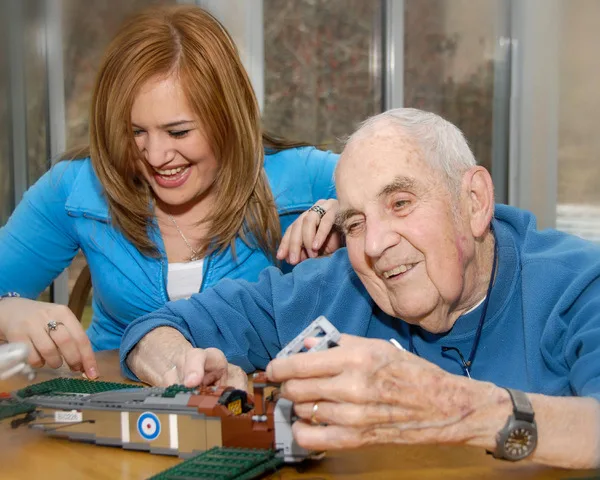
A television can fill a quiet room. It cannot fill the silence that seniors feel the most. Seniors don't just need something to watch. They need someone to respond. Someone who listens, who engages, who reminds them, in small ordinary moments, that they still matter. That's the whole case for senior companionship, and it's one families often miss until the decline has already set in.
It's Never Just Sitting There
From the outside, companion care can look simple. Someone sits with your mother. Someone talks with your father over coffee. But that conversation is doing real work. It's what encourages someone to eat a full meal instead of picking at it alone. It's what gets them up and moving instead of sinking into a chair for the day. It's what keeps a person caring for themselves when no one else is watching. That's what prevents decline before it starts. Families paying for companion care aren't paying for hours on a clock. They're protecting quality of life, one ordinary afternoon at a time.
What Loneliness Actually Does
When seniors are left without regular engagement, the pattern is predictable and it isn't subtle. They begin to withdraw. Appetite drops. Energy fades. Memory starts slipping, not because of age alone, but because there's nothing prompting the mind to stay active and nobody there to notice when something changes.
Loneliness isn't just an emotional weight. It changes health outcomes. It shows up in missed meals, in skipped medication, in falls that go unwitnessed for hours. This is exactly why Euro-American Homecare has stayed strictly non-medical since it was founded in 1989: the work isn't clinical, it's relational, and the relationship is often what catches a problem before it becomes an emergency.
When They Lose a Spouse, They Lose More Than a Person
For many seniors, companionship isn't a nice extra. It's closer to survival. When someone loses a spouse of forty or fifty years, they aren't just losing a partner. They're losing a routine, an identity, a shared history that no one else can fully understand or replace.
Companionship becomes a safe place to talk about that loss again, and again, and again if needed. That repetition isn't decline. It's processing grief in real time, at whatever pace it actually takes, without a clock running on it.
Without the formality of a therapy session or a scheduled check-in, it's simply someone sitting across the table saying, "I hear you. I'm here." Sometimes that's more powerful than anything else you could offer.
Someone Who Notices
A good companion becomes the family's eyes and ears. They show up on holidays. They share meals. They notice when something feels off, an untouched plate, a missed pill, a mood that's shifted, long before it becomes a crisis a family finds out about after the fact.
This is where the difference between a generic sitter and a trained companion really shows. For your loved one's safety, every caregiver at Euro-American Homecare goes through a rigorous 10-step screening process before ever being placed with a client, and the agency hires roughly 8 percent of everyone who applies. Each one also completes four mandatory trainings, plus client condition-specific training, before they start. Families across Hartford, Middlesex, and New Haven counties aren't getting whoever's available. They're getting someone vetted specifically to notice the small changes.
The Spark That Needs an Audience
Seniors still want to tell their stories. They still have opinions, and they still want to laugh with someone who gets the joke. But without a person there to receive all of that, it doesn't disappear all at once. It fades quietly, one conversation at a time, until it's gone. Companionship is what keeps that spark alive, because a story needs someone listening, and a joke needs someone to land on.
What Families Don't See When They Look at the Cost
It's easy for families to look at companion care as a line item, another expense on top of everything else aging brings. What they don't always see is everything it prevents. It prevents depression. It prevents the kind of rapid decline that happens when isolation sets in unchecked. It catches warning signs that would otherwise go unnoticed until a hospital visit forces the issue. And more than any of that, it restores something we're all afraid of losing as we age: the feeling of still being human, still worth someone's time.
Independence Without Isolation
Most seniors want the same thing. They want to stay in their own homes, on their own terms, for as long as they possibly can. But they don't want to do it alone. Companionship bridges that gap. It says: you're still here, still thinking, still feeling, still wanting to be part of something bigger than four walls. You're not done. You're not forgotten. You still belong.
Companionship isn't a luxury. It's a lifeline, and for a lot of families in Hartford, Middlesex, and New Haven counties, it's the difference between a parent quietly fading and a parent who's still, in every sense that matters, still living.
If you're weighing companion care for a parent or loved one, Euro-American Homecare has been serving Connecticut families since 1989 with multilingual caregivers who are screened, trained, and matched to fit. Call 860-829-0208 or visit homecare4u.com to talk through what companionship could look like for you and your family.